By Aaron Krol
May 8, 2015 | “Imagine
for a second that you are a professional racecar driver,” Jason Burke told the
audience at the 2015 Medical Informatics World Conference this week. Chief
Information Officers, IT vendors, clinicians, and standards advocates had
gathered together in downtown Boston to discuss the state of the IT systems
that form the nervous system of modern healthcare centers, and Burke, like many
of his fellow keynote speakers, was pulling no punches.
“You show up to the biggest race of the year, and your team
has been working on this new car,” he continued. “You notice that on the
dashboard of this vehicle there are 87 different gauges. So you look at your
pit crew chief and you say, ‘I notice there are a lot of new gauges here. Can
you point me to where the speedometer is?’ And the pit crew chief says, ‘Well,
we didn’t have room to put the speedometer in because the race track requires
us to install these 87 gauges… These gauges give you a continuous feed of what
is going on with your vehicle, on a 45-minute delay.’
“We’re doing that today in healthcare, every single day,” he
concluded. “It needs to be disrupted.”
Burke, who serves a unique role at UNC Health Care as Senior
Advisor for Innovation and Advanced Analytics, was frustrated with an issue
that would recur throughout the conference: the large and growing web of
metrics used by providers and government to measure patient care, which play
major roles in the financial incentives of the U.S. healthcare system through
programs like Meaningful Use, which funds care centers based on the
capabilities of their electronic health record (EHR) systems.
Two trends, both positive on balance but saddled with
complications, have converged to create this problem. First, there is the increasing
digitization of healthcare, as the large majority of providers have now adopted
EHRs. Second, there is the slower transition from fee-for-service to
value-based care models, a profound change in priorities that is still in its
infancy.
As Jonathan Weiner, Director of the Center for Population
Health Information Technology at the Johns Hopkins Bloomberg School of Public
Health, observed at the conference, these two trends go hand in hand. He
pointed to a study of those care centers that are experimenting with new
value-based models, where providers and physicians are reimbursed less on the
basis of the services they provide, and more on the basis of how much patients’
health outcomes are improved. “Transformation of healthcare and reform is
synonymous with having not only an EHR, but an EHR that meets Meaningful Use,”
Weiner said. “If you look at the accountable care organizations, the
patient-centered medical homes, the pay-per-performance, it’s almost synonymous
with having a high-end EHR.”
Yet the speakers at Medical Informatics World were far from
seeing Meaningful Use and other top-down quality assurance programs as
unalloyed goods. “Meaningful Use has become a big impediment,” declared Steven
Stack, President-elect of the American Medical Association (AMA), who believes
that the program increasingly penalizes providers for not meeting obscure
requirements rather than rewarding them for making the most of digital records.
He added that his organization is continuing to negotiate with the federal
government over changes to the program.
The rapid adoption of digital systems has confronted
healthcare with an unprecedented volume of data, and that data is more
standardized, more sharable, and more available than ever before (though big
improvements are still needed on all three counts). As a result, it’s much
easier for providers to track large numbers of metrics about their patients,
clinicians, and practices — and be held accountable for improving those
metrics.
Yet there have been few efforts to narrow down the universe
of possible features of care that can be measured, either to those that most
directly reflect the quality of the patient experience, or those that make the
biggest difference to health outcomes.
“What we call ‘quality measures’ are really representations
of good clinical practices,” said Burke — practices like hand washing or
administering cancer screens. These are important, but miss the big picture for
which providers should truly be accountable: whether they are providing the
best value to patients. “We should not get confused that quality, as we’re
framing it, is some kind of analytically driven, evidence-based way of driving
higher performance.”
Phil Polakoff, a national healthcare consultant, put it
simply. “From my point of view, there are way too many metrics,” he said. “I
only have three: functional status, morbidity, and mortality.”
Expanding Access
Health IT might seem like too narrow and technocratic a
field for high passions, but the speakers at Medical Informatics World were zealous
and at times emotional. That’s because the stakes are high in a national
healthcare system with unsustainable costs, wide inequalities in health
outcomes, growing epidemics of chronic disease, and far too many preventable
medical errors. Intelligent use of information technology, especially with
coordination and cooperation across providers, could play a role in alleviating
all these problems, yet professionals in the field have frustrations with
vendors, regulators, and hospital administrators alike.
Stack was especially irked at the idea that physicians’ widely
documented dislike of EHRs is a sign of technophobia or conservatism. “It would
really be a misrepresentation to say we do not embrace and adopt technology,”
he said, after noting that, while most doctors are unhappy with their EHRs, an
AMA survey found that over 80% were against returning to paper records. “We use
technology as voraciously as any and arguably more so than most. EHRs are
technology that were not ready for prime time and do not work.”
The lack of interoperability between EHRs at different
providers has been one of the biggest knocks against these products, although
this year many of Medical Informatics World’s speakers sounded optimistic that
incentives are aligning to bring the meaningful exchange of data closer. But
Stack was also concerned that the data collected in EHRs is unreliable,
difficult for clinicians to use during care, and too rarely contains the most
important information about patients. “You’ve got doctors using this incredibly
expensive, incredibly unfunctional technology, printing off 70-page documents
and faxing them to other people,” he said. “It is perfectly legible and utterly
incomprehensible. There is so much garbage in those things that most of us feel
the record is not a useful tool in most of the provision of care that we do.”
Burke has been especially focused on these issues in his
work at UNC, where his team implements predictive models that try to comb
through the data UNC collects for the most relevant metrics to improving health
outcomes — in essence, surfacing the speedometer on his racecar and making sure
it’s visible to doctors and administrators. That work calls for a lot of
rigorous data collection, but it doesn’t mean that every data point needs to be
presented to clinicians or actively monitored for “quality.”
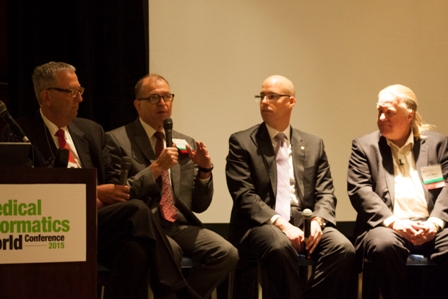
A keynote panel meets on Wednesday, May 5, at the Medical Informatics World Conference in Boston. From L: Phil Polakoff; Stanley Huff, Chief Medical Informatics Officer of Intermountain; Steven Stack; and Jason Burke
The speakers were also at pains to emphasize that health IT
is a broad and expanding field. “EHRs are one type of digital health or health
information technology,” said Stack. “They are not health information
technology.” He pointed to telehealth as another type of tool that could make a
substantive difference in patients’ lives, particularly those who live in rural
areas or for other reasons find it difficult to meet with their physicians.
John Halamka, CIO of Beth Israel Deaconess Medical Center, was
equally enthusiastic about mobile health, explaining that middleware like
Apple’s HealthKit development platform was making patient-gathered data far
more accessible to providers. With an environment like HealthKit, hospital CIOs
no longer have to implement one-to-one interfaces with each type of device they
want to draw data from, and Apple handles many of the privacy and consent
questions. Now that it’s relatively feasible for doctors to connect with their
patients’ digital scales, activity monitors, or glucometers, the bigger
question is how this can have a useful impact on care.
Halamka, who serves as an informal advisor to Apple, is also
intrigued by the Apple Watch. Halamka’s mother, he said, takes three
medications and sometimes forgets a dose. “So if she wears an Apple Watch, and
the watch has taptics, it taps you and says, ‘It’s 2:00. Here’s a picture of
the med you should take,’” he suggested. “And then once you take it, you tap
the watch and say I’ve taken it, and you now have closed-loop medication
administration records where the patient is involved in medication compliance.”
New Threats
While Halamka was animated about new technologies that bring
data collection closer to the patient, part of his keynote address took a
darker turn. One of his major responsibilities as CIO is protecting Beth Israel
Deaconess’ IT systems from cyberattacks, and the pace and nature of these
attacks has become radically more threatening in recent years.
Halamka told the audience that his hospital network, along
with several others in the Boston area, had recently encountered a dedicated
denial of service attack from Anonymous, whose primary target was Boston
Children’s Hospital. “As CIOs of course we all prepare our Internet borders for
the usual kinds of Internet malfeasance, but distributed denial of service
attacks from hacktivists wasn’t one of the things we put into our initial
disaster plan,” he said. “We’re seeing organized crime, state-sponsored
cyberterrorism. You wouldn’t believe the kind of strange stuff we’re seeing.”
This theme was underscored by Stephen Warren, CIO of the
Department of Veterans Affairs, who revealed that his agency blocked 1.2
billion malware attempts this March alone. The data available in health centers
is growing more valuable at the same time cyberattacks are growing more
sophisticated. Most of the responsibility for combating attacks will fall on
CIOs and their departments, but, Warren said, other members of the care system
need to be aware of digital vulnerabilities. Technicians, for example,
sometimes expose computerized medical devices to the Internet, all but
guaranteeing they will be infected with malware.
“The majority of medical devices are XP-based. We don’t talk
about it,” said Warren. “XP is an operating system that Microsoft hasn’t been
supporting for a year. What we have found is, if you put an XP device on the
Internet, within seven seconds it’s compromised.”
Despite the high security demands of his job, Warren was
most eager to share the VA’s experience modernizing the way it works with
medical records. The agency’s EHR, VistA, is widely admired as one of the most
clinician-friendly systems in service, but recent efforts have focused on
smoother communication with outside systems generally, and the Department of
Defense specifically. (For more on interoperability in military health, see “In
Defense Department’s Health IT Overhaul, a Crossroads for American Healthcare.”)
To this end, the VA has embarked on several big EHR
innovations simultaneously. One insight was that the most important factor is
often not whether data can be transferred between providers, but whether
clinicians can view the most relevant patient data in another provider’s
records. The VA has already implemented a system that allows physicians in both
the VA and DoD to see each other’s records without moving the data, and is
working on a wider rollout to third parties.
The agency has also committed to Blue Button, an initiative
to let patients personally download their own records, which Warren admitted
was “very primitive when it started.” Today, however, he says, “the scope of
the data is larger and larger, and now we’re reaching the point where we’re
going to add images into it… The idea is that as an institution it was not our
right to withhold [patients’ data], it was our obligation to give it back.”
One project Warren mentioned, an integration with Walgreens
pharmacies, also hinted at ways to expand the discussion about medical data
beyond sharing between providers. “When a veteran goes into Walgreens and gets
their flu shot, it shows up in the VA’s medical record,” he said. That kind of
routine extension of the digital system into patients’ daily health activities
could help build a much more informed, and informative, view of overall health
than care centers currently access.
The Medical Informatics World Conference will meet again next year on April 4th and 5th at the Seaport World Trade Center in Boston.