By Tina Galasso, Bernadette Collins, and Paul Ivsin
May 5, 2015 | Contributed Commentary | Researchers and clinical study managers
have been dreaming for years of the day when a patient’s every experience with
the healthcare system is aggregated in a network of interoperable Electronic Medical
Records (EMRs) that can be seamlessly cross-referenced. When that day comes,
assessing the feasibility of clinical trials and even delivering information on
clinical trials to potential patients will be easier than ever before. While we
will not enjoy this ideal anytime soon, there is currently the potential to use
a combination of data sources—both EMRs as they exist today and other patient-level
databases—to support feasibility assessment and patient outreach for clinical
research.
The Current State of EMRs
The U.S.
Department of Health and Human Services (HHS) has published a strategic
plan to guide widespread adoption of health IT from 2015-2020. The Plan’s
goals are to increase the electronic collection and sharing of health
information to improve health, healthcare, and reduce costs. Among the more
specific objectives imbedded in these broad goals is one to advance research,
scientific knowledge, and innovation.
Although HHS is
developing a “National Interoperability Roadmap,” EMR systems are not yet
capable of sharing “patient
health information electronically across organizational, vendor, and geographic
boundaries.” This lack of interoperability, of course, limits the current application
of electronic records for clinical research purposes. However, there are
innovative approaches being developed now to serve as a workable stopgap until
patients’ complete medical histories are captured in a universal database.
Feasibility Assessment Using EMR
and Prescription/Medical Claims Data
Even today, EMR data (derived from system vendors and large provider
networks), can be combined with longitudinal prescription data and medical
claims data to estimate the number of eligible patients for a given clinical
trial. The combination of data sources is important because, at this point,
none contains all of the necessary medical
details on patients to assess their suitability for a trial. For example, EMR
data include vital statics and lab values that may not be available in medical
claims data.
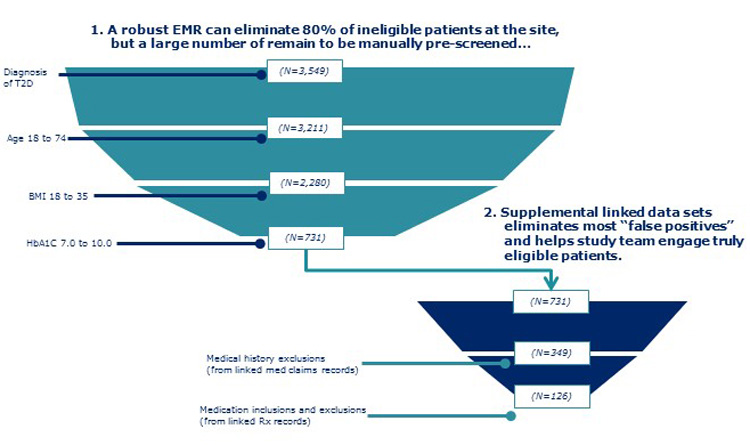
In this methodology, depending on the trial protocol, various data
assets are used alone or in combination to estimate patient counts. The
starting point is to search local site EMR databases for potentially eligible
trial participants. This initial list can then be cross-referenced against prescription
and/or medical claims databases to assess each patient’s eligibility according
to trial inclusion/exclusion (I/E) criteria that cannot be determined from the
EMR record. As can be seen in the
“attrition funnels” presented in Figure 1, no dataset on its own is sufficient,
but collectively, they are able to address the full set of I/E criteria, to
produce a realistic estimate of eligible patient counts.
Patient Outreach at Site of
Care, Pharmacies
In the foreseeable future, it should be possible for clinicians to receive
electronic alerts of trials of potential interest to specific patients during
the treatment visit and based on a
comprehensive medical history.
A modified form of such alerts is possible today, albeit based only on
the information contained in the host EMR system. For example, a Principal
Investigator (PI) working at a large university health system may, after
entering a patient’s data, see an automated message about the patient’s
possible suitability for a given trial. That alert, however, will likely have
many false positives, because it will be based only on the contacts the patient
had with the health system; it will be missing information about the patient’s
visits with other, external physicians and facilities.
With the right database linkages, researchers would be able to link individual
EMR systems, prescription records, and medical claims databases automatically
to develop a more complete patient profile against which the trials’ I/E would
be matched. The alerts that PIs see would, therefore, be much more refined and
targeted.
Similarly, large pharmacy systems can, and do, identify patients who
may be suitable for clinical trials and contact them on behalf of trial
sponsors. However, once again, the search is generally limited by the scope of
the information in the pharmacy system. With links to EMR systems data and
claims data, pharmacy service providers would be able refine their matches of
patients to potential trial candidates using a more comprehensive set of
I/E. This ability to better target
patients should dramatically increase the success rate and return on investment
of such outreach programs.
Clearly, creating the type of database linkages and automatic searches
just discussed will require coordination across entities, careful contracting
between parties, and ensuring that the methodologies conform to all privacy
legislation. However, the necessary technology, information, and market demand
exist today to make these concepts a reality.
All three authors work in Clinical
Trial Optimization Solutions at IMS Health. Tina Galasso is Senior Manager,
Data Services team; Bernadette Collins is Senior Manager, Data Services team; and
Paul Ivsin is Director, Offerings Development.