By Aaron
Krol
September 23,
2014 | Nearly two months have passed since the FDA announced its intention to
start regulating laboratory developed tests, or LDTs, by mid-2015. These tests,
which are designed, made and performed entirely in a single laboratory, have a
huge footprint in the American healthcare system, and have often been on the
front lines of innovation in areas like personalized medicine and cancer
diagnostics. They are also the only in vitro diagnostic tests, or IVDs, that
aren’t required to submit data to the FDA proving their safety and accuracy,
although the labs that perform them do need to be certified under the Clinical
Laboratory Improvement Amendments (CLIA).
In the nearly forty years that LDTs have enjoyed this policy of
“enforcement discretion,” they have grown from a small but vital niche used
mainly by hospital labs to diagnose rare diseases, to an industry where big
players like Myriad Genetics and Genomic Health can post profits in the
hundreds of millions of dollars. Conventional IVD manufacturers have been
crying foul, and the FDA agrees that its LDT policy has led to some perplexing
outcomes. “It certainly calls into question why a company would go through the
entire regulatory process, if they can just open their own clinical lab,” says
Katie Serrano, from the FDA’s Office of In Vitro Diagnostics. “And we’ve seen
cases where they have done exactly that. The larger manufacturers have said, to
heck with this PMA [premarket approval] process, we’re just going to open our
own CLIA lab.”

Tests performed on patient samples, like blood, spit, or tissue biopsies, must be cleared by the FDA — unless developed and performed by a single laboratory. ©iStock.com
At the same time the FDA declared that enforcement discretion was
coming to a close, it also released an oversight framework explaining what it
will require of labs that run LDTs, and the timeline for implementation. (For
details of the proposed regulations, see “FDA
Announces Plans to Regulate Laboratory Developed Tests.”) As
mandated by Congress, the FDA has extended 60 days’ notice before officially
issuing this framework as a draft guidance, but that period ends on September
29, and so far, the document appears likely to be issued more or less as
written.
“It’s about time,” says Tadd Lazarus, CMO and Head of Global Molecular
Diagnostics at QIAGEN, a large IVD manufacturer whose tests have sometimes
competed with LDTs. “This is the first major push with a tight timeline, and I
think it’s the right rulemaking at the right time.”
“We’ve all been bracing for it to come,” adds Judi Smith, who as Vice
President for In Vitro Diagnostics at the consulting firm Precision for
Medicine has advised both IVD manufacturers and CLIA labs on regulatory issues.
“The IVD industry has been saying, have a level playing field. When we develop
kits, we have to go through an approval or a clearance process, and [the FDA
requires] very stringent analytical and clinical studies to be performed.”
The three main provisions of the oversight framework will all be
familiar to IVD makers. Labs that perform LDTs will have to compile a list of
the tests they offer; have a new mandate to report adverse events, including
deaths or serious injuries to patients; and, most importantly, must submit to
premarket review of any tests that the FDA designates as high- or medium-risk.
This review could take the form of a PMA submission, which would typically
include a clinical trial — the largest expense IVD manufacturers face when
bringing a new test to market.
But most labs that develop LDTs aren’t commercial giants. The large
majority are affiliated with hospital systems and academic centers, and they
are raising alarms about what LDT regulation will mean for clinical care at
their organizations. Uncertainties still surround almost every aspect of the
proposed regulations, including just how many LDTs are out there, and whether
the FDA even has the authority to regulate them. But for lab directors around
the country, the biggest question is whether hospital and academic labs can
continue offering their in-house tests at all, or whether the high cost of clinical
trials will sink their operations.
Pain Points
and Clinical Trials
Outsiders might be surprised to hear that the FDA prides
itself on flexibility and openness to change. Members of the agency sincerely
believe that their job is to help new products win approval, and they try hard
to get this message across whenever they get the chance.
“We work with
people who have great ideas all the time to help them through this regulatory
process,” says Serrano. It’s a point that comes up often, as a burst of new
technologies has challenged some of the traditional ways the FDA validates products.
Next generation sequencers, for instance, can capture countless types of
genetic variation, far too many to verify that every possible test result is
accurate. And genetic diagnostics for rare diseases may need to consider dozens
of related mutations, making it impractical to find a relevant patient
population for a clinical trial. “The applications, and getting the appropriate
studies to support claims that are made, are the trick,” Serrano adds. “We are
trying to be flexible and creative, but still maintain our standards for these
new technologies.”
The agency’s recent track record bears this out. Last November, the
FDA gave its first nod to a next generation sequencer, the MiSeqDx. The review
involved a limited study in which just 13 clinical samples were sequenced, and
a representative set of calls was analyzed for accuracy. The FDA also cleared
two cystic fibrosis tests for the instrument, and instead of insisting on a
clinical trial, allowed the manufacturer to test cell lines and refer to a
well-curated online database of cystic fibrosis mutations.
Lazarus says that QIAGEN, too, has benefited from discussions with the
FDA about its regulatory submissions. “The FDA creates a pre-submission
dialogue,” he says, “a space where everyone has the ear of the agency, and
where questions and concerns can be addressed fully. By the time we as
manufacturers submit, we can get a lot of the pain points under control.”
So the FDA would like labs to believe that there will be many routes
to LDT approval, and that the agency is prepared to help tailor submissions
that are appropriate to each test. In particular, it wants to soothe some fears
about clinical validation, the standard that a premarket review should show not
only that a test is accurate, but also that it offers a health benefit to
patients.
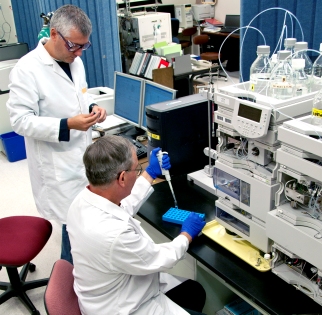
Labs increasingly rely on complex computer pipelines to analyze the results of testing, opening new questions about validation. Photo by Michael J. Ermarth for FDA.
This will be a difficult sell. The gold standard for clinical
validation will always be a clinical trial, tracking patients long enough to
collect data on their health outcomes, and clinical trials are hugely
expensive. Even on the low end, they cost hundreds of thousands of dollars to
conduct and take months to complete. For budget-constrained academic labs,
alternative sources of validation, like databases, peer-reviewed literature,
and studies on existing tissue samples, may be the only feasible options, and
it’s not always clear when the FDA will find these acceptable.
Serrano would like labs to focus less on clinical trials, and more on
clinical practice. “The question we’re trying to get at is, what does your
measurement mean in context?” she says. “How would a physician make a decision
based upon that test result?” But she also acknowledges that the FDA is wary of any submission that can’t reference known patient outcomes, and that
clinical trials remain the best way to demonstrate safety and efficacy.
“With something that’s very novel, sometimes we have to follow it
through, because the community doesn’t know how to interpret that value or that
analyte,” says Serrano. “Whereas with, for example, glucose or vitamin D, those
are pretty well established, so we wouldn’t be looking for anything new to
establish clinical utility.”
Of course, laboratory pathologists will see a lot of gray area between
a glucose test and a completely novel analyte. As LDT regulations move forward,
a great deal will hinge on just where the requirements for clinical trials
fall.
The
Question of Harm
The FDA is convinced its new stance on LDTs is necessary to protect
patients in a changing healthcare system. Representatives of the agency have
cited cases like OvaSure, a test offered by the company LabCorp in 2008 to
detect the early stages of ovarian cancer. Independent studies showed the test
was less effective than the standard of care, with one study
reporting that OvaSure’s biomarkers had just 34% sensitivity. Nevertheless, the
FDA was only able to shut the test down by claiming that, because it had been
developed at Yale and not in-house at LabCorp, OvaSure didn’t qualify as an
LDT.
Serrano says there may be many more examples, but they’re hard to
track down. “Because these tests aren’t required to make any systematic
reporting of adverse events, it’s difficult to get this information,” she says.
The FDA has to rely on third-party investigations to flag problems, and may
lack enforcement options if they arise.
On the other hand, it’s unclear how much risk is posed to patients even
by unreliable LDTs. Results from the tests are always communicated to
physicians, not directly to patients. Particularly with speculative tests like
OvaSure, physicians tend to shy away from recommending drastic medical
interventions without some supporting evidence, like a family history of
disease. In a webinar addressing the proposed LDT regulations on September 16, hosted
by the Association for Molecular Pathology, Roger Klein of the Cleveland Clinic
told attendees he had a hard time imagining any LDT result leading to the kinds
of extreme patient harm that would trigger an adverse event report to the FDA.
The agency is not so relaxed. In its oversight framework for LDTs, it
names several categories of tests it believes could lead to disastrous patient
outcomes, including blood tests for infections in immune-compromised patients,
and tests used on healthy patients to predict the risk of serious conditions
like heart disease.
Perhaps most importantly, it also singles out companion diagnostics,
which recommend the use or disuse of specific drugs, as falling in the highest
risk category. That means these
tests would be the first to go through premarket review under the proposed
framework. If the FDA finds companion diagnostics unsafe or inaccurate — or if
a lab decides it can’t afford to file for approval — they could be pulled off
the market as early as next fall.
The FDA prefers companion diagnostics to be developed, and used in a
clinical trial, alongside the drugs they indicate. But especially in cancer
care, where companion testing is increasingly routine, labs see good reasons to
develop tests on their own, and worry that their ability to do so will soon be
sharply limited.
A High Risk
Area
Cancer Genetics, Inc. (CGI), a midsized commercial test provider based
in Rutherford, NJ, launched its first test in 2011, a genetic probe for patients
with chronic lymphocytic leukemia. Since then, the company has built up a menu
of dozens of molecular diagnostics, and now does about one million dollars of
business a month, half of which is testing for hospitals and other care
centers. Most of CGI’s tests are prognostic, trying to gauge the severity of
cancer cases based on tumors’ genetic makeup. A few, however, like solid tumor
testing for KRAS, BRAF and EGFR mutations, could be used to recommend specific drug regimens.
Like other LDT providers, CGI receives patient samples in
the mail — its tests cannot legally be performed outside its CLIA lab — and
consults with clinicians over the results, helping them interpret the often
complex matrix of mutations found in a given tumor. Oncologists who want an even
broader look at a tumor’s unique genome can work with a company like Foundation
Medicine, whose Foundation One test sequences the whole coding regions of over
300 cancer-related genes.
This thirst for genetic information is a result of a rapidly
evolving view of cancer itself. “You have to have a real appreciation for the
biology of these diseases,” says Panna Sharma, CGI’s President and CEO. “There
are over 90 different subtypes of leukemias and lymphomas, all with different
outcomes and different genomic profiles. Seven or eight years ago, we certainly
didn’t have that depth of knowledge… It’s already making a difference in
treatment.” For some types of cancer, like non-small cell lung cancer and
certain melanomas, that difference is profound, and thanks to the abundance of
LDTs in this arena, it has largely bypassed the FDA.
There are compelling reasons clinicians have leaned on LDTs to
diagnose and treat cancer. One is the pace of technological change: when the
FDA first started approving companion diagnostics, genetic testing was limited
to narrow methods like polymerase chain reaction. As next generation sequencers
expanded what was possible in genetic medicine, molecular pathology labs rushed
to take advantage of them, designing new tests to run on these powerful but
unapproved instruments. Even today, only a small minority of labs own an
FDA-cleared MiSeqDx, and no cancer panels have been approved for the device.
Then there’s the state of genetic knowledge itself, which is changing
at a rapid clip. Take mutations to the KRAS
gene, which are known to affect patients’ response to certain colon cancer
drugs. In 2012, the FDA approved QIAGEN’s therascreen test for seven KRAS mutations, and many labs replaced
their LDTs with the new, FDA-validated test. But additional KRAS mutations are speculated to have
the same effects, and some oncologists want tests to detect these, too. LDTs
can swiftly fill the gap, while QIAGEN would need to compile new data on safety
and efficacy before it could make any changes to the therascreen test.
“If these labs didn’t offer these tests, and attempt to make available
new technology, I think we would have stymied the pace of innovation,” says
Sharma, whose own company is planning to introduce its first next generation
sequencing tests by early 2015.
Companion diagnostics are used to recommend specific courses of therapy, heightening the FDA's concerns for patient safety. ©Forestpath
Sharma isn’t a pessimist about new FDA regulations. “Adverse event
reporting, quality maintenance, reporting of when tests work and don’t work — I
think all those are well overdue,” he says. But he does believe LDTs have
offered labs the freedom to pursue new testing options for patients with
difficult diseases.
“[Premarket reviews] will add cost, and they could delay innovation,”
says Sharma. “A lot of companies don’t have the infrastructure or capital to do
this kind of work, so a lot of things you see in the pipeline… will face some
challenges. I think there will definitely be companies that fall out.”
Still, there are steps companies like CGI can take to minimize the
disruption, even while working in higher-risk testing areas. Sharma says that
the same adverse event reporting procedures his company uses for overseas
testing will meet the FDA’s standards back home. Most importantly, he has
worked with hospital partners, including the Cleveland Clinic and Memorial
Sloan-Kettering, to collect and publish data on CGI’s test results on an
assortment of patient samples. That wealth of data should give the company a
leg up when discussing clinical validation with the FDA.
Ultimately, Sharma believes that CGI will take regulations in stride, and
his industry may even benefit from greater assurances that its products are
effective. In terms of submitting new tests for premarket review, he says, “the
broader picture is that something that would have taken months might take a
year. I think that’s a reasonable tradeoff to improve safety and develop a
model that investors and operators of businesses can feel comfortable with.”
Down in the Trenches
Sharma can afford to be sanguine about LDT regulations. CGI is a
successful business, with a steady stream of clinical customers — and more
sales on the research side, which can help support new products before they are
cleared for clinical use.
Many academic and hospital labs see the proposed regulations in a
whole different light. Nina Longtine is the President-Elect of the Association
for Molecular Pathology (AMP), an advocacy organization for the field of
molecular diagnostics and one of the fiercest opponents of FDA
involvement in LDTs. She was also the founder of the molecular diagnostics lab
at Brigham & Women’s Hospital, and now serves as Vice-Chair of Molecular
Pathology and Genetics in the Mount Sinai hospital system.
Longtine, like other AMP members, believes that labs like hers already
work within a robust regulatory environment, thanks to CLIA certification,
which is administered by the Centers for Medicare and Medicaid Services (CMS)
and must be renewed every two years. CLIA inspections review the reagents and
instruments a lab uses, and the professional training of the technicians, to
ensure that tests are analytically accurate.
IVD manufacturers are quick to point out that this still gives LDTs leeway
other tests don’t enjoy. “LDTs can be used clinically on patient specimens for
months or years before a laboratory seeks CLIA or CAP [College of American
Pathologists] certification,” says Lazarus. “[And] these are certifications
that the lab is able to perform the test. They are not vetting the genomic
targets for clinical efficacy.”
But Longtine sees a huge gulf between a company like QIAGEN mass
producing reagents, and a molecular pathology lab like hers operating closer to
patients. “We’re not a manufacturer,” she says. “We don’t make an instrument,
we don’t make reagents. We use our own professional expertise to design and
develop and validate and interpret. It requires a different framework that
recognizes that professional input.”
The new oversight of LDTs comes at a time when labs are
already feeling under siege from regulators. Last year, CMS undertook a massive
overhaul of the Clinical Laboratory Fee Schedule, the coding system by which
labs are reimbursed for testing. The old system was well known to be broken,
and labs generally welcomed a new set of codes developed by the trusted
American Medical Association, but the transition was badly bungled. Unsure what
rates to set for each new testing code, CMS let regional billers choose their
own pricing in a “gap-fill” process.
As a result of the large gap-fill, in many regions of the
country, months passed without labs being reimbursed at all. Even after the
issue was resolved, many labs remained critical of CMS’ downward pressure on
pricing, particularly in genetic testing. “There was a whole year where we almost
got no reimbursement, because CMS hadn’t put any dollar values along with their
new codes,” says Longtine. “We’re really being tested, to be able to deliver
innovative testing at very low cost, because reimbursement is so poor.”
Sharma has been feeling the same pressures at CGI. “I think there’s a
real disconnect in government, in terms of how they view the role of genomic
medicine in our country,” he says. “It’s very frustrating. They want to add
more layers of cost, yet there’s no thoughtfulness about how we make sure these
companies continue wanting to innovate.”
The FDA doesn’t make reimbursement decisions, and sees its role
strictly as protecting patients from unsafe or ineffective products. But the
impression labs get of the two main regulators is often of the right hand not
knowing what the left hand is doing. This has soured the idea of new LDT
regulations from the start, despite broad agreement even at organizations like
AMP that the FDA is well-intentioned and wants to get the best care to patients.
A Big Job
for a Beleaguered Agency
AMP doesn’t even like the term “LDT.” Its members prefer “LDP,”
for laboratory developed procedure, emphasizing that these aren’t products you
can pick off the shelf, but often a complex set of lab practices that can
involve numerous sample preparation steps, computer analysis, and expert
interpretation.
“This is not so much a medical device,” says Longtine. “It’s a medical
practice that I’ve devoted my entire career to.”
The term LDP isn’t just a semantic quibble. It’s aimed pointedly at
the limits of FDA authority, which extends to medical devices but not to the
practice of medicine. At first glance, this ploy seems unlikely to make much
headway: the definition of “medical device” was explicitly written to cover testing
of patient samples when the FDA was given the power to regulate devices in the
1970s. But the LDP theory does have high-level supporters, including Rep. Mike
Burgess (R-TX), who has fought to keep LDT oversight firmly under CMS.
Legal resistance to the new LDT oversight, either through
congressional action or a lawsuit challenging the FDA’s authority over the
tests, is still a possibility, and a September 9 congressional hearing about
the proposed framework quickly turned contentious. At that hearing, Rep.
Burgess asked whether the oversight framework was being issued as a draft
guidance to avoid an economic review by the Office of Management and Budget,
which would be triggered if the framework were issued as a formal rule.
Longtine shares this concern that the financial impact of regulation is
not being seriously considered. “Before we move down this road, we should see
how it’s really going to affect the economy of healthcare, and of laboratories,”
she says. “That doesn’t seem to be on the agenda.”
The FDA believes it has always had the power to regulate LDTs, but has been practicing "enforcement discretion." Not everyone agrees. Image by FDA
Members of the hearing also questioned the FDA’s capacity to take on
LDT regulation in addition to its other responsibilities. While Serrano says
the agency plans to regulate these tests with its current resources, this could
prove difficult given how large the LDT industry has grown.
It’s an open question how many different LDTs are out there. “It’s
very difficult [to estimate],” says Serrano, “because there is no systematic
way to collect information about these tests.” But she says the FDA’s best
guess, based in large part on figures from New York State, which does track
laboratory testing, is that there are around 11,000 labs offering LDTs around
the country. The FDA believes around half of these labs’ tests are of minimal
risk to patients and won’t need to go through a clearance process.
Critics of the oversight framework say this volume of LDT submissions
would dwarf the FDA’s normal caseload of PMAs. Alan Mertz, president of the
American Clinical Laboratory Association, told Congress that the agency
approved just 23 original PMAs last year, as reported
by Turna Ray at GenomeWeb. (Other sources
repeated that figure to Clinical
Informatics News; curiously, the FDA website lists only 21 original PMAs
approved in 2013.) Even more dramatically, just four of those PMAs were for
diagnostic tests, while the rest supported more conventional devices like heart
valves.
Yet the focus on original PMAs is misleading. The FDA also
processes a much larger number of 510(k)s, or submissions to clear a new device
that is “substantially equivalent” to an already approved device. A test is
eligible for a 510(k) if it is used for the same purpose as an existing low- or
medium-risk test, and data can be produced showing it does not raise new
concerns about safety and efficacy. That data may be hard to collect to the
FDA’s satisfaction, and a 510(k) is not necessarily an easier route to approval
than a PMA. But it is a much more common one: in 2013, the FDA processed over
3,000 510(k) submissions.
Nonetheless, it’s clear that LDTs will represent more than
just a drop in the bucket of the agency’s review schedule. The oversight
framework suggests a nine-year timeline for reviewing every LDT currently on
the market, but even then, says Longtine, “I question the FDA’s ability to handle
all the things that they’re suggesting. I think it’s huge.”
A Tight
Path to Approval
Longtine is blunt about the prospects for labs like hers securing FDA
approval for their in-house diagnostic tests. “It would be a huge challenge,
and probably the end of academic laboratories, if we expected academic labs to
go through some type of PMA process,” she says. “People spend millions of
dollars on that, while we can make only a couple hundred dollars on a test.”
Judi Smith at Precision for Medicine agrees that a PMA is probably out
of reach for most academic labs. From her experience with commercial IVD
manufacturers, she estimates a typical PMA, including a clinical trial, would
cost at least $1 million, a cost that would be prohibitive in niche areas like
personalized medicine. “The reason personalized medicine is going through LDTs
first is because these assays don’t have a huge demand,” she says. “The
business model isn’t there to go through the FDA.”
From this perspective, it may matter less how cooperative the FDA is
in helping design clinical trials, and more what mechanisms exist to get around
them. Some tests, especially if they are similar to previously approved IVDs
and don’t fall in the highest risk categories, could get by on support from the
scientific literature, an established FDA practice that labs should find
encouraging. “I do think that relying on published papers that have shown
clinical validity should be a very helpful starting point, rather than having
to collect your own patients and run a trial,” says Longtine.
The oversight framework also offers a few exemptions from premarket
review, designed to protect vulnerable patient populations that are especially
reliant on LDTs. These include continued enforcement discretion for rare
disease tests, and for “unmet needs,” covering any LDT that has no FDA-approved
equivalent.
The unmet needs exemption is a generous gesture, showing the FDA doesn’t
want to disrupt the practice of healthcare, but it only applies to labs testing
patients within their own hospital systems, leaving some patients without testing options. Serrano says the close
communication between labs and physicians in the same care center will help
minimize any risks to patients. “Ultimately, the lab and the physician need to
be working together, especially in these cases where they don’t have as much
information about the performance of the test, to make sure they’re making the
right decision for the patient.”
But labs worry that their in-house tests will be repeatedly pushed out
as FDA-approved tests fill previously “unmet needs,” even when labs invest
heavily in their own, preferred solutions. The definition of an unmet need
isn’t crystal clear, and the FDA would most likely, for instance, see the KRAS test niche as filled while a lab feels
its broader look at the gene is indispensable. Then there’s the issue of
platform lock. The FDA-approved therascreen KRAS
test is tied to a specific instrument, QIAGEN’s Rotor-Gene Q, while LDTs for
the same purpose could use a lab’s existing instruments.
For both the FDA and companies like QIAGEN, specifying platforms is a
feature, not a bug, offering better quality control and more consistent
results. “Our genomic targets have been clinically vetted by FDA, and the onus
of quality is on us,” says Lazarus. “Our manufacturing processes, our sourcing
of components, our continuous quality improvement and quality assurance,
providing them with a fully formed kit on a specific platform — everything is
designed to go together seamlessly.”
Getting to
Yes
Whatever labs’ fears about these highly controlled pipelines, however,
the very existence of FDA-approved tests could lighten the load for labs who
want to use their own tools and processes for the same patients. “Most
academic laboratories aren’t trying to develop a brand-new test that has never
shown clinical validity,” says Longtine. “What we’re doing is trying to provide
an efficient test that has documented clinical validity in some clinical
trials, which our doctors can then use to evaluate their own patients.”
If that’s the case, academic labs may be closer than they think to meeting
premarket review requirements. As the FDA has lately demonstrated with its
high-profile clearances of sequencing tests, if clinical utility can be
convincingly shown without a new clinical trial, the agency is open to looking
at new testing methods that measure the same analytes. CLIA regulations already monitor the
analytical accuracy of LDTs, which should help assure the FDA
that labs can meet the same standards as approved IVDs using their own procedures.
As a regulatory counsel, Smith’s advice for labs is to be consistent
with their testing pipelines, always validate any changes to the reagents or
instruments used, and keep supporting data about their test results, even if
it doesn’t reach the level of a clinical trial. “Make sure you have a report of
some type with your supporting data saved somewhere, so you can pull that off
the shelf if you need it for an FDA submission,” she says.
If a test is truly novel, she adds, the barriers to approval will be
much greater, but reaching out to the FDA early can go a long way. “It is very
difficult, when you’re developing a test that is far ahead of the currently
accepted gold standards,” she says. “Think outside the box of traditional
validations. Think about other tests or methods that are out there to help
support your claim. And then go to the FDA and negotiate with them.”
As for the draft guidance due to be issued next week, it won’t be set
in stone. Advisory committees are slated to advise the FDA on which LDTs should fall in high- and medium-risk categories. Even the highest risk category, which
the agency has already outlined, will be subject to revision. Serrano says that
laboratory pathologists, clinicians, and patient advocates will all have
opportunities to weigh in, and that the rare disease and unmet need exemptions
may also be broadened if the FDA sees this as in the interest of patients.
“We wanted to put something in the framework to give people a sense of
what’s coming, because people want to make plans and start to get their
documentation in order,” says Serrano. “We see this as starting the discussion
with the community, not necessarily where we’ll end up.”
Academic labs don’t have regulatory affairs departments, and there’s
no doubt that any new regulations will add costs that may be a strain on
hospital resources. But they don’t have to be the end of innovation in the lab,
if both the FDA and the labs it regulates keep an eye on alternative methods of
validation, and accept that cutting-edge areas like personalized medicine will move
only gradually to a perfect clinical understanding of the risks and benefits of
testing.
In the meantime, LDT providers want to head off the idea that, because
they have operated independently from the FDA, they are somehow unscrupulous or
unconcerned with how their tests affect patient care.
“One of the things that seems to be lost in these discussions is that,
while regulations are important, so is the professionalism of the people who
are running the laboratories,” says Longtine. “You don’t want people to have a
misperception that because it’s a lab developed test, it’s not a good test.
It’s up to us to make people trust and understand that these are well run, well
executed tests, and the patient on the other end is of the utmost importance to
us.”