By Aaron Krol
July 10, 2014 | In
remote regions of sub-Saharan Africa, health authorities are giving more and
more thought to how they can deliver health services to patients far from large
medical hubs. For diagnostic companies, point-of-care testing has become a
critical frontier for the adoption of new technologies in low-income nations. Despite
the daunting design challenges — shrinking devices, simplifying workflows,
freeing chemistry from the cold chain, leaving the controlled environment of
the lab, all while keeping the costs of testing at or below the status quo — the
industry is increasingly focused on making diagnostics that can travel with
operators wherever they’re needed.
“In these resource-poor settings,” says Fred Farber, CTO of
Cambridge, MA-based Daktari Diagnostics, “the problem is that if you take a
blood draw and send the blood to a central lab, you might be able to get the
results tomorrow, but the patient is long gone.” Taking the entire test out of
the lab and into community care centers may be the only way to reach those people
for whom long-distance travel is a struggle or outright impossible.
Yet comparatively little thought has been given to the
opposite problem: getting test results back from the field into central labs.
This too is an important element of point-of-care testing. In resource-limited
countries, central laboratories are often more than the physical housing for
the most advanced equipment and best-trained operators. They’re also the central
nervous systems of national health services, tracking disease patterns across
wide areas and keeping close tabs on the accuracy and reliability of testing.
“They have big chemistry systems attached to LIM [Laboratory
Information Management] Systems, and the lab managers are capable of monitoring
various aspects of their diagnostic system, including the health of the
instrument itself, how well the operators are doing, and any quality control
that’s being run,” says Farber. “Their big concern [with point-of-care
testing]… is that they will lose control of the instruments and how well
they’re running.”
At Daktari, which is preparing to release its first
point-of-care diagnostic in seven African countries, the goal is to provide
central labs with real-time access to data, even when it’s collected in
remote settings. Data transmission is built directly into the company’s
instruments, and a dedicated cloud platform has been built to monitor each
device as it travels from clinic to clinic.
To Farber, this is not an added feature, but a necessity for
making point-of-care testing a focus of national health strategies. “We believe
[this] will become the standard for how these point-of-care devices are
deployed,” he says, “regardless of the test.”
Sending out the Instrument
Daktari’s lead product is the Daktari CD4, an HIV diagnostic
that measures the severity of HIV infections by counting CD4 immune cells. This
is a standard test in HIV care, used to decide when to start a course of
antiretroviral treatment, but it’s normally performed on a flow cytometer, a
large and expensive desktop instrument. Flow cytometers need a constant supply
of reagents, can only be operated by trained technicians, and usually rely on
fragile optical sensors to detect fluorescent markers that have been tagged to
the cells being counted — all major obstacles to their wider adoption.
This has made CD4 counting a bottleneck for bringing
antiretroviral drugs to the HIV infected.
The situation is dire enough that a dedicated charity, Cytometry for Life, has
existed since 2006 just to sponsor the development of cheaper, more portable
instruments. While Daktari is not associated with that campaign, it does share
the same basic goals, and its Daktari CD4 device could be considered a sort of
stripped-down flow cytometer.
“Our instrument is the size of a cassette player, and can be
thrown in the back of a hummer and driven wherever it needs to go,” says
Farber. Instead of optically detecting cells, the Daktari CD4 measures
electrical impedance: after internally separating out cells with a
CD4-specific antibody, it slices open the cells, releasing ions that create a
predictable electric signal. This strategy cuts down on both the instrument’s
bulk, because there are no optical sensors, and the complexity of the chemistry
involved, because cells don’t have to be fluorescently labeled. All the
chemistry is prearranged in a disposable cartridge, just waiting for a blood
sample to be inserted.

A field test underway in the town of Kalisizo, Uganda. Image credit: Daktari Diagnostics
The system is still in field testing; to be put into active
use, it will have to meet the regulatory standards of all seven countries where
it’s being demonstrated — Ethiopia, Kenya, Malawi, Mozambique, Tanzania,
Uganda, and Zimbabwe — plus Doctors Without Borders, which is a major purchasing
agent in all these countries and has its own vetting process for new
diagnostics. Initial rounds of testing, however, have been positive enough for
Daktari to set up a manufacturing facility, due to open this October, and a
$2.68 million UNITAID grant has provided the company with enough funding to complete
its field trials. Daktari hopes that its CD4 test, which takes just 14 minutes
to run and which Farber estimates will cost around $10 a cartridge, will soon
be a viable alternative to sending blood samples to labs.
“It allows for treatment decisions to be made while the
patient is available to the healthcare worker,” says Farber. “You [can] take
this point-of-care device out to the community health center, and a patient
will come into the center and have their blood test.”
Bringing in the Data
While the Daktari CD4 test is simple to administer, it
involves a surprisingly high volume of data. Measuring electrical impedance
isn’t a one-off operation — as CD4 cells are gradually lysed in the chamber,
the instrument needs to take constant measurements to catch each change in the
signal. “The test takes 14 minutes,” says Farber, “and we read a signal every
second, so you can do the multiplication – that’s how many pieces of data we
get from each run.” In addition, the instrument makes 15 quality controls
checks every run to make sure nothing has gone awry with the device, the
cartridge, or the operator. These include basic measures like making sure the
solution in the cartridge has no ion contamination before cell lysis, and
checking that the operator placed enough blood in the cartridge.
It’s enough data that, during field testing, Daktari has been
using the Quantrix Modeler data analytics platform to compare each run against
a traditional lab test. Farber has been running analyses to make sure that the
Daktari CD4 gives the same results as a flow cytometer, and that variables like local temperature or which operator is running the test don’t affect its accuracy. “One
of these clinical trials is, say, 300 samples,” says Farber. “It would be hard
to put that much data into Excel, and then get each worksheet to process the
same way every time. Quantrix automates that kind of multi-dimensional, large
dataset analysis in a way that’s relatively easy to use.”
But 300 runs is only a fraction of the testing a fleet of
Daktari devices could perform as part of a concerted national health plan. Each
instrument can run for three days and nearly 100 tests without needing a new
battery charge. With huge areas and widely dispersed populations falling under
the authority of a single central lab, the instruments could well be used right
up to that capacity.
That volume of testing highlights the need for fast and
reliable data transmission. Internal quality control checks are of little use
if central management can’t see the results and trust in treatment decisions at
the time they’re made. To address this, Daktari taps into the growing mobile phone
networks of the countries where it’s active, and makes sure that transmission
is the device’s responsibility and not the operator’s.
“We call it the Kindle model,” says Farber. “We have a built-in
SIM card buried inside the instrument that the user can’t access.” After a test
is performed, the Daktari CD4 checks for connectivity, and if it’s available,
sends the results and associated quality control checks to a dedicated cloud
server. If the on-the-spot transmission fails, the instrument can also store
readings until connectivity is reestablished.
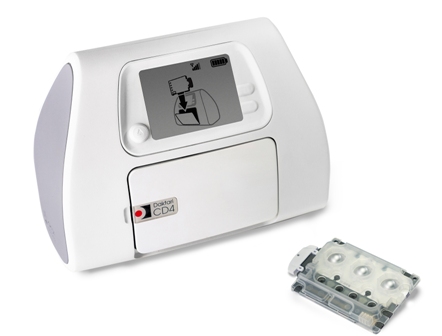
A Daktari CD4 instrument and cartridge. Image credit: Daktari Diagnostics
The web portal for the devices is called Daktari InSight,
and it offers different features tailored to the needs of its users. For
central labs and health ministries, says Farber, “our basic screen is a map of
your country, and it shows you where every instrument is all the time: when the
last time it ran a sample was, what the results were, the users who used it.
It’s a useful way to think about the deployment of your fleet.” From that view,
management teams can check the history of any specific instrument, and will
also be alerted if any quality control metrics are out of range. Daktari
receives the same information itself, to proactively service any instruments
that have stopped functioning properly.
Meanwhile, clinicians who make active treatment decisions
get an extra layer of information, to identify the patients who undergo
testing. That makes it easier to integrate results into any health records that
are kept, and refer back to them over time. To everyone else, the patients
remain anonymous.
Daktari InSight is built to offer a convenient view of the
devices, and not to be a limiting platform. “[Users] have access to
the data in any format they want,” says Farber. “We can give them an API, so
that they can write an integration to directly feed their LIMS… It’s their
data, it’s not our data.” This is an important feature for central labs, which
will have systems already in place to monitor the testing that goes on in their
jurisdictions.
Daktari has been working on its CD4 test for around five
years, and also has viral load tests underway for both HIV and hepatitis C.
While the company’s first impulse was to solve portability problems in
point-of-care testing, its vision has expanded as the Daktari team has coordinated
more closely with national health systems.
“It became clear to us that a market requirement was to give
[labs] access to the same sort of information they’re getting off of their LIM
Systems,” says Farber. Like any health authority, central labs and ministries
of health in sub-Saharan Africa want holistic pictures of the care administered
under their aegis, and data they can trust as it’s collected. Expanding access to diagnostics is a crucial problem for African health networks, but it won’t be solved without the active engagement of central labs in overseeing tests. Farber believes the Daktari InSight model makes the company’s testing more accountable and better suited to the systems in which it’s being placed. “We feel like it really is a requirement for getting this
technology adopted.”