By Aaron Krol
April 2, 2014 | In April 2009, Clinical
Informatics News spoke to Tommy Littlejohn, then serving as President of startup
company Clinical Ink, about
a tablet-based data capture platform going through pilot testing as a tool
for investigators in clinical trials. The platform, called SureSource, was
meant to replace electronic data capture (EDC) systems as a way to record data
from patient visits in a form that trial sponsors and managers could use for
statistical analysis. While EDC platforms required paper documents to be
manually reentered into a trial database, Clinical Ink hoped that redesigning
the source documents themselves would provide a simpler and more reliable solution.
 Since that story was published, SureSource has been launched
as a polished commercial product, and has been used in approximately 50
clinical trials over five continents. It has not only become a viable
alternative to EDC in any study, but also carved out a niche enabling clinical
trials with unique mobility and ease-of-use requirements. This February,
Clinical Ink took home the top prize at Clinical
Informatics News’ inaugural Best
Practices Awards in the category of “Study Startup and Design,” at the fifth annual Summit for Clinical Ops Executives (SCOPE), in
recognition of its significant cost-saving role in a tuberculosis drug study conducted
in Tanzania and South Africa.
The Importance of
Source Data
The company’s early growth was not easy. “In 2006 or 2007,
no one was talking about source – much less eSource,” says Doug Pierce, the co-founder
of Clinical Ink who succeeded Tommy Littlejohn as President. “I had someone at
a major pharma company tell me he didn’t care if the investigator chiseled the
data into stone, as long as he got it on time. Nobody really understood the
importance of how source data is captured.”
Pierce realized that ignoring source data was imposing real
costs on trial sponsors. Because the data from patient interactions was
recorded with pen and paper, there was a constant chance of introducing errors
when this data was copied to the EDC. Funding had to be earmarked for monitors
who physically travel to the sites to check the source documents, and any
errors that could be flagged by electronic monitoring of source data went
undetected until transfer to the EDC, long after the patient interactions
ended. Moving electronic capture upstream, by creating eSource documents that
run on tablet computers, would solve all these problems at a stroke – something
that Pierce, who ran a paper medical forms business in Winston-Salem, was
keenly aware of.
However, the hurdles to convincing investigators to adopt an
eSource platform were high. “[Paper and pen] works really, really well,” says
Pierce. “Everyone uses it, everyone knows how to use it, no one picks up a
legal pad and a pen and says, ‘How do I enter data?’ We knew that, for an
eSource system to be useful, it had to be as intuitive and familiar as we could
possibly make it.”
At the time, he adds, the idea of using tablets seemed
strange and exotic. “The early tablets we were walking around with in 2007 were
novelties. We would pull them out at meetings, and people would gather around
and say, ‘What’s that?’” Clinical Ink’s challenge was to convince trial
sponsors that investigators would take to these futuristic devices as easily as
pen and paper.
The company spent years creating a “paper-like” platform to
meet these demands. Users interact with SureSource using a stylus, and can fill
out data fields in their own handwriting, which the platform converts to plain
text. Outside these core data fields, SureSource is as freeform as paper. “You
can write anywhere you want to on the digital page, just like you can on a
paper page,” says Pierce. “So if you want to write a marginal note next to a
field, to offer some contextual information, you can do that. You can quickly
draw a diagram, or draw a body to indicate where a wound is.” These marginalia don’t
have to be interpreted by a middleman during transfer to an EDC; when an
investigator is ready to submit a form, the pages are uploaded to the SureSource
web portal exactly as they appear on the tablet.
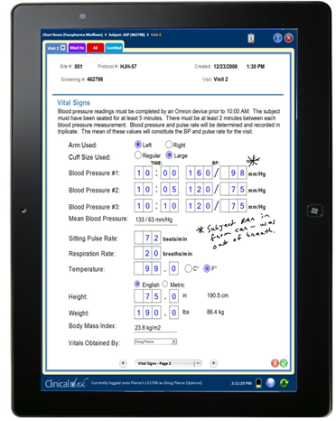
A page from a source record displayed on a tablet running SureSource.
Image credit: Clinical Ink
Clinical Ink also had plenty of time to perfect their sales
pitch. CEO Ed Seguine joined the company in 2009, having previously worked as
an investor in EDC companies like Phase Forward. (Seguine has the distinction
of being the first person to be associated with Best Practices Awards from both
Clinical Informatics News and our
sister publication Bio-IT World,
having worked at Medidata when that company
was honored in 2009.) “I looked at Clinical Ink, and said, ‘This has the
clearest connection to actually reducing costs of any technology I’ve seen,’”
Seguine remembers. “We can point to explicit cost savings that happen right
now, saving cash out of pocket, that make the difference in the decision to
implement a new technology.”
Those savings come from eliminating monitor visits to
compare source documents to the data in the EDC. “By definition, whatever is
written in the tablet is what is in the database,” says Seguine. “You can
review the document – not just the data, but the document itself – remotely on
a website.” Combined with the ability to perform edit checks in real time –
flagging source data that’s out of range or otherwise suspect while the patient
is still in the room – this economic logic began to win over interested
partners. The 2010 release of the iPad also helped to gradually establish
tablets as everyday tools. In December 2011, Clinical Ink signed its first
contract to deploy SureSource in a live clinical trial, and the company has
only grown from there.
Sure Source in Action
Over time, SureSource has revealed strengths beyond its
cost-saving potential. The platform has proved a useful tool for highly
distributed studies, where sites and sponsors span multiple countries, and in
areas where Internet connectivity is limited. In the case study that secured
Clinical Ink its Best Practices Award this year, SureSource was deployed in a
trial of multiple drug combinations for treating tuberculosis, including the
novel drug SQ109. This trial was sponsored by a consortium of European
universities called PanACEA (Pan African Consortium for the Evaluation of
Antituberculosis Antibiotics), carried out by the contract research
organization Triclinium based in South Africa, and conducted across seven sites
in South Africa and Tanzania, resulting in a need for rapid communication
across continents.
Because an Internet connection is only needed at the points
when forms are first downloaded and uploaded, investigators in this trial could
work in a platform where their documents would be fully visible to
collaborators online, despite limited connectivity. Training investigators in
SureSource is a minimal investment, which can be done online or in face-to-face
meetings. After the initial deployment of SureSource, PanACEA and Triclinium
found that they could exert powerful oversight of the study without frequent
field visits.
“One of the great things about an eSource tool like ours is
you have access to source data that you never have access to in a typical
trial,” says Pierce. Checking the latest statistics, he’s able to tell me that
161 investigators in this study have met with 609 subjects in a total of nearly
11,000 visits, filling out over 3.5 million data fields. Across all this
information, an average of just seven fields per subject have prompted queries
from Triclinium or PanACEA, which Pierce calls a “remarkably low” figure – and
all of these queries have been addressed without traveling to the site.
“The data is coming in so clean that the study no longer
uses a separate data management CRO, because there’s not a high volume of data
cleaning to deal with,” adds Seguine. “The reduction in monitoring costs meant
that they could expand the footprint of the trial, and concentrate on actual
patient activities, and not administrative overhead.”
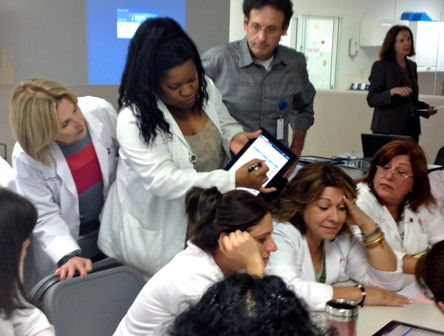
Doug Pierce (top) oversees a SureSource training session at SeaView Research
in Florida. Image credit: Clinical Ink
While Clinical Ink didn’t have underserved disease areas
like tuberculosis in mind when SureSource was in development, Seguine and
Pierce are very gratified that their platform can help empower this kind of neglected
research. “The goal has always been to improve the efficiency and reduce the
cost of clinical trials,” says Pierce. “That becomes even more important when
dealing with diseases that primarily impact the low-income world. The fact is,
these drugs don’t always return the same amount of money as a drug that
improves the lot of more affluent people, so keeping the cost down on those
studies is even more important. We’re very pleased that the approach we’ve
taken has proved to be useful for those sorts of trials.”
There are other novel use cases where SureSource has had an
unexpected edge over EDCs. Novartis has adopted the platform for a trial of
beta agonists taking place in Walgreens pharmacies, whose Healthcare Clinics
serve basic medical needs for a large number of Americans. “There are roughly
300 of these clinics, and they’re research naïve,” says Seguine. “[SureSource]
means Novartis doesn’t have to send monitors to all 300 sites, and the tablet
can help to enforce some of the protocol requirements.” For clinicians who have
never worked as investigators in clinical trials, guidance in an electronic
platform can clear up issues before they develop – for instance, prompting the
clinician to take extra readings if a blood pressure measurement is out of
range.
SureSource can also satisfy privacy and mobility concerns.
In a UK-based study of a potential Alzheimer’s treatment, researchers take
their tablets outside the study site each day to nursing homes where the
non-ambulatory subjects live. “The coordinators didn’t want people wandering
around with charts full of information that was highly private and
confidential,” says Pierce. “So they travel to the nursing home, they gather
the data, they can check that data in before they leave the site, and then they
travel back home.” By the time the visit is over, the source documents are in a
secure cloud and ready for review and analysis.
The Universe of
Source Data
For the first iteration of SureSource, ease of use and
faithful data capture have been Clinical Ink’s greatest priorities. A few early
features, however, such as electronic prompts and queries that are attached
directly to source documents on the web portal, are pointing to ways that a
tablet platform can actually improve on paper.
Seguine emphasizes that SureSource documents are never
converted into PDFs, or other static formats, until trial managers take them out
of the web portal. “Inside our system, it’s an interactive document,” he says, “and
we feel that’s critically important for some of the things we’re planning for
the future – to be able to interact with labels and fields and data values.
Querying is just one way, potentially, of interacting with SureSource.”
The platform also has the potential to expand from patient
visits to other kinds of data gathered in clinical trials. Clinical Ink is
planning to build software for laboratories, so test results can be captured
electronically and made available in the same environment as the direct patient
data. The company is also working with clients to move data through the next
stage of a clinical trial’s lifecycle: submission to regulators.
“We’ve recently built
out a utility that allows us to aggregate all the visit information for a
single subject, and put it in a regulatory compliant submission format, so sponsors
can submit the documents alongside the data,” says Seguine. This gives
regulators a direct pipeline to the patient visits, adding extra assurance of
the data and helping to speed up any questions about conduct at the sites.
Ultimately, the hope is that SureSource will become a large
suite of software tools that can streamline data collection at any stage of a
clinical trial. In the meantime, hundreds of tablets running SureSource have
already been distributed around the world, and the platform is making an
immediate impact on the cost of research. Combining greater reliability of
trial data with measurable savings, and enabling both novel and neglected use
cases, Clinical Ink exemplifies best practices in clinical studies.
Clinical Informatics News
will begin accepting entries for the 2015 Best Practices Awards in August 2014.
Contact: Allison Proffitt: aproffitt@healthtech.com, 617-233-8280.